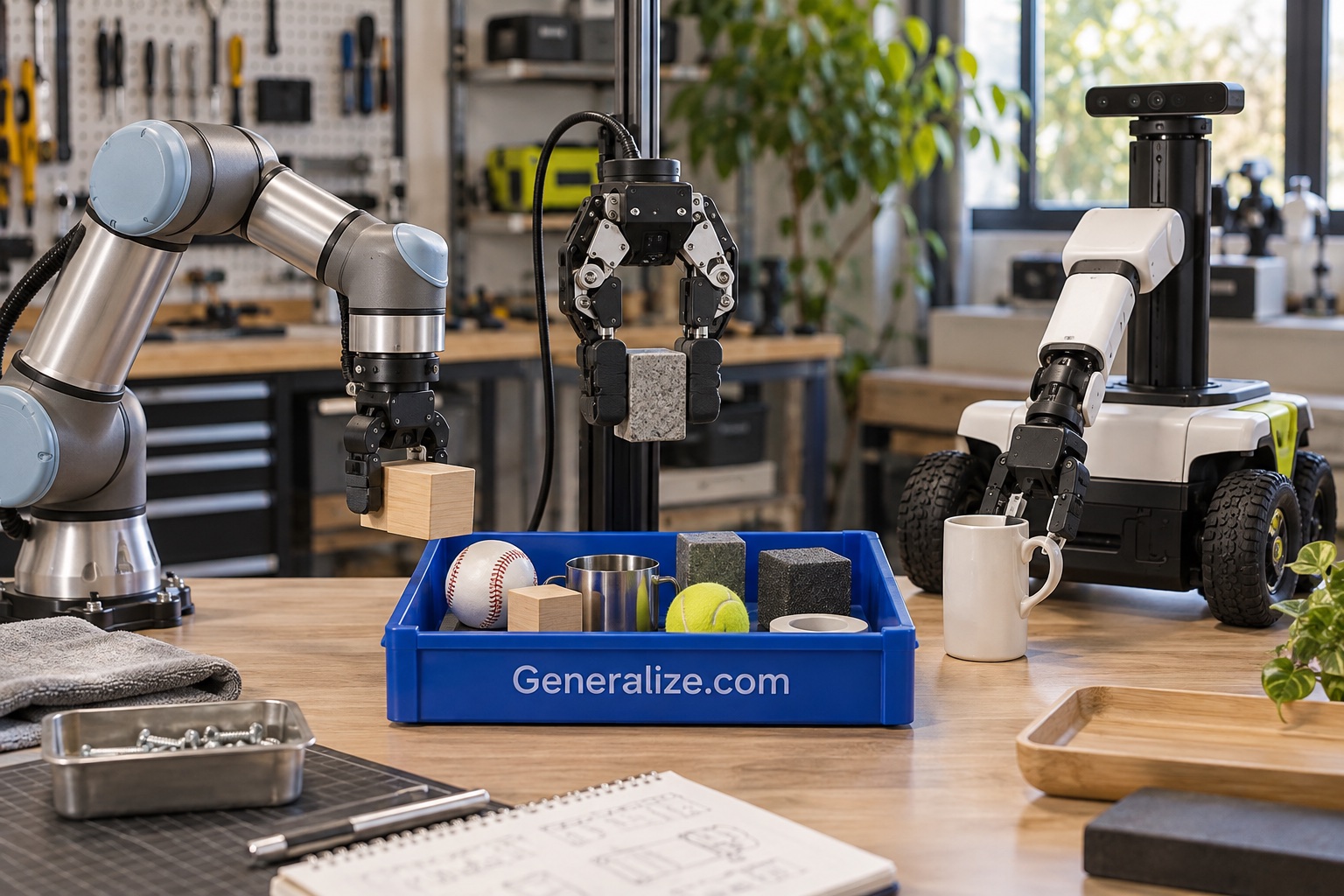
Robot datasets often look compatible at the level of a task label. Several robots may all open drawers, move cups, or place objects in containers. Underneath that label, their cameras, joints, grippers, control frequencies, coordinate frames, and action representations can be quite different. A Generalize.com data product could help teams decide what can be learned across those bodies and what must still be adapted locally.
This is an illustrative company concept. It draws on the research direction demonstrated by Open X-Embodiment, a collaboration that assembled data from many robot embodiments and tasks. The originating project and paper should remain the source for its specific experiments and reported results. A commercial product would need to avoid turning a research finding into a blanket promise of transfer.
The buyer has data, but not a common language
The likely early buyer is a robotics or embodied-AI team choosing between training only on its own demonstrations and incorporating outside datasets or pretrained models. A research lead may see the potential. A platform engineer sees the mismatch. A product owner wants to know whether the work will shorten the path to a target task.
The first offer could be a cross-embodiment data audit. A buyer provides a target robot, task family, sensors, action interface, and candidate datasets. Generalize.com maps the compatibility gaps, documents licenses and access conditions, and proposes a measured adaptation plan. The deliverable is not “more data is better.” It is a record of what the datasets actually contain and what transformations would be required.
That first service could become software once patterns repeat. A catalog could expose dataset cards, embodiment metadata, task vocabularies, sensor schemas, and action-space adapters. Teams could filter candidate sources by properties that matter to their target system instead of downloading large datasets based only on a broad task name.
Normalize descriptions before values
Normalization is often imagined as rescaling tensors. The harder work begins earlier: determining whether two fields mean the same thing. One dataset may describe end-effector movement in a robot base frame. Another may store joint commands. A third may record absolute poses in a world frame. Gripper state can be binary, continuous, force-based, or absent. Camera streams may differ in viewpoint, resolution, synchronization, and calibration.
Generalize.com could use a layered schema:
- Embodiment: robot model, kinematic structure, joints, gripper, payload, reach, base mobility, and control interface.
- Sensors: camera placement, calibration, depth, proprioception, force or torque sensing, and sample rates.
- Task: natural-language instruction, structured task label, objects, scene, success definition, and termination condition.
- Actions: representation, coordinate frame, units, frequency, limits, and whether commands or observed states were recorded.
- Episode quality: completeness, interventions, resets, failure labels, and known synchronization issues.
- Rights: source, license, permitted uses, attribution duties, redistribution limits, and any access terms.
This schema would not make every dataset interoperable. It would make incompatibility visible, which is a useful product in its own right.
A worked audit
Consider a team building a two-finger gripper system for tabletop sorting. It finds three candidate sources. Dataset A uses a similar arm but a different camera view. Dataset B uses a mobile manipulator with wrist and head cameras. Dataset C records a suction gripper and stores only high-level waypoints.
The audit first checks task overlap. “Sort objects” may hide different goals: grouping by color, moving named items, or placing every object into any bin. Success labels need to be reconciled before episodes can be compared.
Next comes observation compatibility. Dataset A may have useful joint and end-effector state but require visual viewpoint augmentation. Dataset B may contribute varied scenes while including base motion that the target robot cannot perform. Dataset C may offer object diversity but little direct value for learning finger closure. The product should show these limits instead of assigning one compatibility percentage with false precision.
Action mapping follows. Where actions can be converted into a shared end-effector representation, Generalize.com could document the transformation and validation checks. Where information has been lost, such as unrecorded force or low-frequency waypoints, the record should say so. An adapter that produces valid-shaped data is not necessarily a valid physical mapping.
Finally, the audit proposes evaluation. The team might pretrain on the compatible portions, fine-tune on a smaller set of demonstrations from its own robot, and compare against a local-data-only baseline. It should test both familiar and shifted objects, record repeat trials, and preserve failures. Positive transfer is a measured outcome, not an assumption built into the project plan.
Metadata is a product, not paperwork
Cross-embodiment work is expensive when important context lives in lab notes or author memory. Good metadata turns that context into something another team can inspect. Generalize.com could give dataset contributors validation tools that catch missing frames, unknown units, inconsistent timestamps, or incomplete robot descriptions before publication.
The platform could also track lineage. If a dataset is cleaned, relabeled, transformed, or merged, users should be able to trace the source episodes and transformation code. A model trained on a mixture should have a reproducible manifest of the versions and filters used. This supports debugging when a policy behaves differently after a data update.
Licensing belongs in the same workflow. A research dataset may permit certain uses while restricting redistribution or requiring attribution. Model terms can differ from dataset terms. The platform should display originating terms and dates, preserve links, and encourage legal review for the intended use. It should not summarize a complex license into a green checkmark that teams treat as legal advice.
Distribution through the data supply chain
The clearest distribution path is through robot manufacturers, research consortia, data-collection providers, and model teams. A manufacturer could publish a verified embodiment profile. A dataset producer could validate a release against the schema. A model provider could state which data and action interfaces its adaptation tools support.
An open metadata specification would lower adoption friction. The commercial layer could offer private catalogs, permission controls, transformation pipelines, compute integration, and audit reports. Teams could begin with one target embodiment and one task family, then expand as the compatibility library grows.
Trust would depend on restraint. The company should not advertise every dataset as universally useful. It should distinguish observed compatibility from measured transfer and measured transfer from deployment readiness. It should also make clear when results come from the source researchers rather than independent replication.
What must stay local
Even strong cross-embodiment pretraining does not erase a target robot’s physical reality. Joint limits, latency, calibration, compliance, gripper behavior, payload, camera placement, and control software remain local. Fine-tuning data may be necessary. So may new safety constraints and application testing.
The product could turn those needs into an adaptation checklist: verify coordinate transforms, calibrate sensors, test command saturation, confirm stop behavior, collect target demonstrations, choose a baseline, run shifted evaluations, and document unsupported cases. That makes local work visible in budgets and schedules.
A disciplined starting point
A founder exploring this concept should pick one task family and two or three embodiments, not promise a universal robot data layer on day one. Inventory the sensors, action representations, licenses, and failure annotations. Build a compatibility report by hand. Then test whether teams will pay to avoid that audit work and maintain it over time.
Generalize.com fits this idea because the product’s job is to help useful learning travel across physical forms while naming the limits honestly. The domain is available for acquisition. Prospective buyers can inquire privately with the intended market, initial dataset scope, and target embodiment.