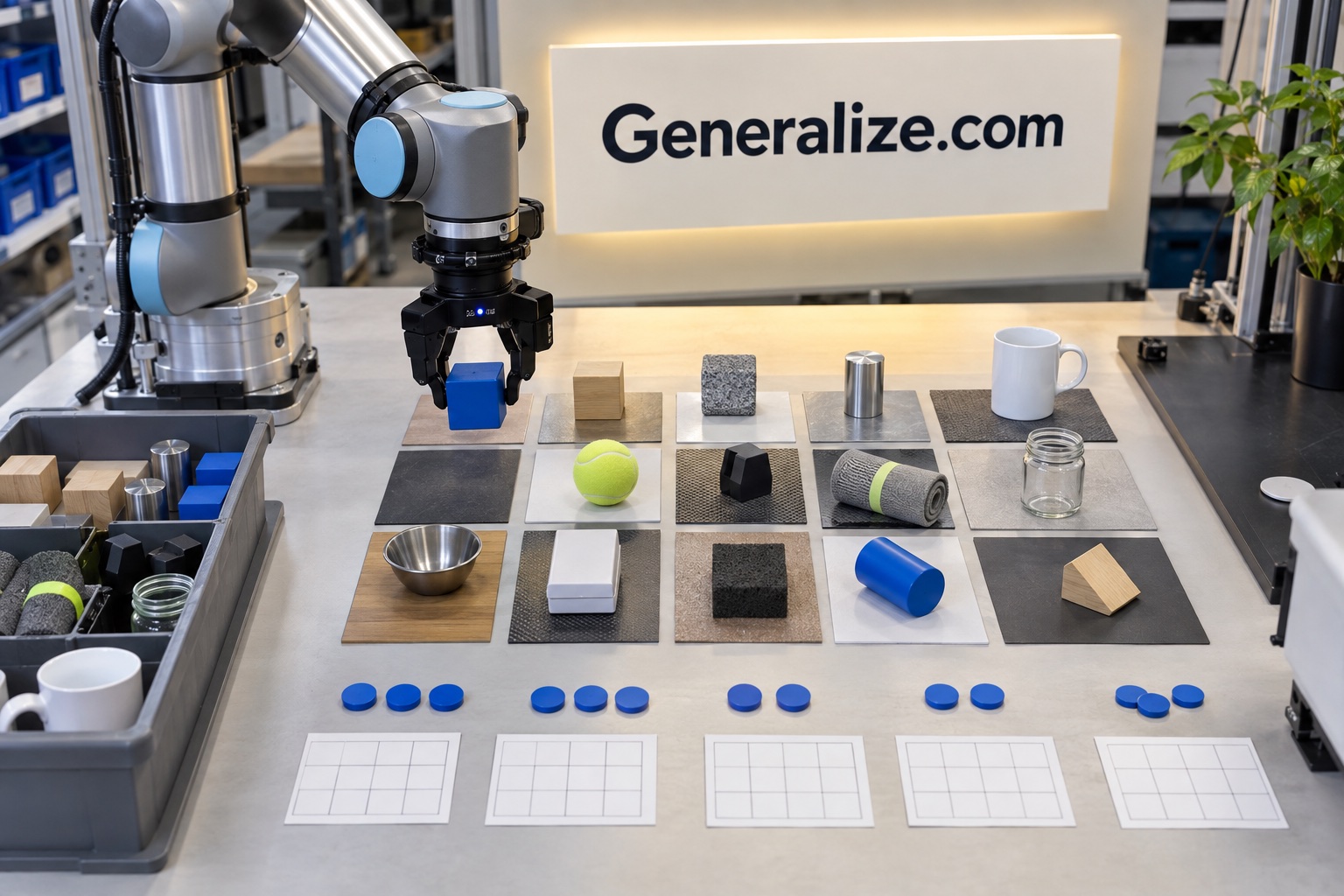
A polished robot demonstration answers one question: did the system complete this task in this setting? A deployment decision asks a harder set of questions. What happens when the object is unfamiliar, the instruction changes, a light casts a new shadow, or the next step arrives out of order? A Generalize.com scorecard could help teams plan and report those tests without collapsing every result into one impressive number.
This is an illustrative business concept, not a current product or recognized standard. Its useful starting point is the discipline behind repeatable tests. NIST describes standard test methods for response robots in terms of specified apparatuses, procedures, and performance metrics. A commercial scorecard would serve a different market, but it could borrow the habit of making the test setup explicit.
The buyer and the first offer
The first buyer would be a robotics product team preparing to move a manipulation, mobile, or inspection system from internal trials into a pilot. The person feeling the pain might be an evaluation lead, field engineer, safety owner, or technical product manager. They already have demos and logs. What they lack is a shared way to say which variations were tested and which remain unknown.
The first offer could be a facilitated evaluation plan rather than a sprawling software platform. The team would choose one deployment task, document a baseline setup, select controlled shifts, set a trial count, and define escalation rules before testing. Generalize.com could provide the worksheet, a lightweight run recorder, a failure taxonomy, and a report that keeps denominators visible.
Starting this narrowly avoids a common trap: trying to invent a universal score for all robots. A warehouse pick, an outdoor inspection route, and a mobile manipulation task do not share the same hazards or success criteria. The scorecard should make comparisons clearer inside a defined application, not pretend that unlike systems can be ranked on one ladder.
Build the matrix around what changed
The matrix would place variation dimensions across columns and task stages down rows. A manipulation example might include perception, approach, grasp, transport, placement, and recovery. For each stage, the evaluator would record the baseline plus selected changes:
- Objects: geometry, material, color, weight, deformability, and clutter.
- Instructions: wording, sequence, ambiguity, correction, and interruption.
- Layouts: position, orientation, reach distance, obstacles, and station geometry.
- Lighting and sensing: brightness, glare, shadow, occlusion, camera position, and sensor noise.
- Task sequence: familiar order, skipped step, repeated step, or a changed upstream condition.
- Embodiment: gripper, arm, base, camera arrangement, control rate, or payload limit.
The evaluator should change one dimension at a time before combining shifts. If object type, lighting, and layout all change in the same run, a failure may be realistic but difficult to diagnose. Single-shift trials establish sensitivity. Combined-shift trials then show how the system behaves in more representative conditions.
A worked example
Imagine a robot that moves sealed cartons from a table to a tote. The baseline uses one carton size, a fixed table position, bright overhead light, and the instruction “place the box in the blue tote.” Twenty baseline trials provide a starting distribution, not a promise.
The next block changes carton size while holding the scene steady. Another block rotates the cartons. A third uses matte and glossy packaging. Instruction tests replace “box” with “carton,” reverse the clause order, or ask the system to stop midway. Layout tests move the tote within the approved workspace. Lighting tests add shadow without dropping below the camera manufacturer’s operating limits.
For each run, the scorecard records task completion, time, interventions, contacts, dropped objects, unsafe motions, recovery attempts, and the stage where failure began. A successful retry after human correction should not be counted the same as an autonomous first-pass completion. A stopped run should retain its reason rather than disappearing from the denominator.
The report would show performance by shift type and severity. It could also list unsupported cases explicitly: unsealed cartons, damaged packages, people entering the workspace, or objects outside validated weight limits. That “not tested” section may be more useful than a composite score because it guides the next experiment and prevents marketing copy from outrunning evidence.
Repeat trials and failure logging
One run is evidence that something happened once. It says little about variability. The appropriate trial count depends on the decision, expected failure rate, operating cost, and risk. Generalize.com should not offer a magic number. It could instead require teams to state the count in advance and explain any exclusions.
Failure categories should be observable and actionable. “Model failed” is too broad. Better labels include object not detected, target confused, unreachable pose selected, grasp slipped, collision stop triggered, instruction rejected, localization lost, and human intervention requested. The product could allow a primary cause, contributing conditions, and links to raw logs.
Video and sensor data need clear handling rules. The evaluation plan should specify retention, access, redaction, and whether people or confidential facilities could appear. A buyer serving regulated or sensitive environments would need appropriate security and privacy controls rather than treating every recording as harmless telemetry.
Distribution through deployment partners
A credible distribution path runs through robotics integrators, simulation providers, and test facilities. Integrators already need acceptance criteria for a customer cell or pilot. A scorecard could become a shared planning document before hardware arrives, then a handoff artifact after testing. Simulation vendors could export planned variations into the matrix while marking which results came from simulation and which came from physical trials.
The company could publish a free starter template for one task and charge for team workflows, evidence storage, approvals, and reporting. Public educational material should show how to write testable shift definitions, not publish invented benchmark tables. Case studies would require customer permission and transparent scope.
What execution would require
The product needs more than a clean interface. It needs a data model that distinguishes tasks, environments, robot configurations, software versions, variation dimensions, individual trials, interventions, and failures. Versioning matters because a policy update, camera change, or gripper replacement can invalidate a comparison.
It also needs careful language. “Generalization score” can sound broader than the underlying test. Reports should name the exact task and shifts evaluated. A scorecard for carton transfer under six controlled variations does not establish general-purpose manipulation, safe operation around people, or readiness for another facility.
Safety stays outside any single metric. Current industrial robot safety standards, manufacturer instructions, regional requirements, and an application-specific risk assessment all remain relevant. Evaluation evidence can inform those processes, but a Generalize.com report should never imply certification or conformity unless an authorized body has actually provided it.
A useful first week
The practical first step is modest: choose one deployment task and write the baseline so another evaluator could recreate it. Select four meaningful shifts. Decide how many repeat trials the decision warrants. Define completion, intervention, safe stop, and failure before running anything. Then make a blank “not tested” list.
That exercise exposes fuzzy claims quickly. It also creates the first product artifact Generalize.com could turn into a repeatable workflow. The name fits because the product would help teams ask what traveled beyond the demonstration, not because it would declare that a robot had generalized in every sense.
Generalize.com is available for acquisition. A buyer building rigorous robot evaluation tools can inquire privately about the domain and describe the intended product, team, and next step.