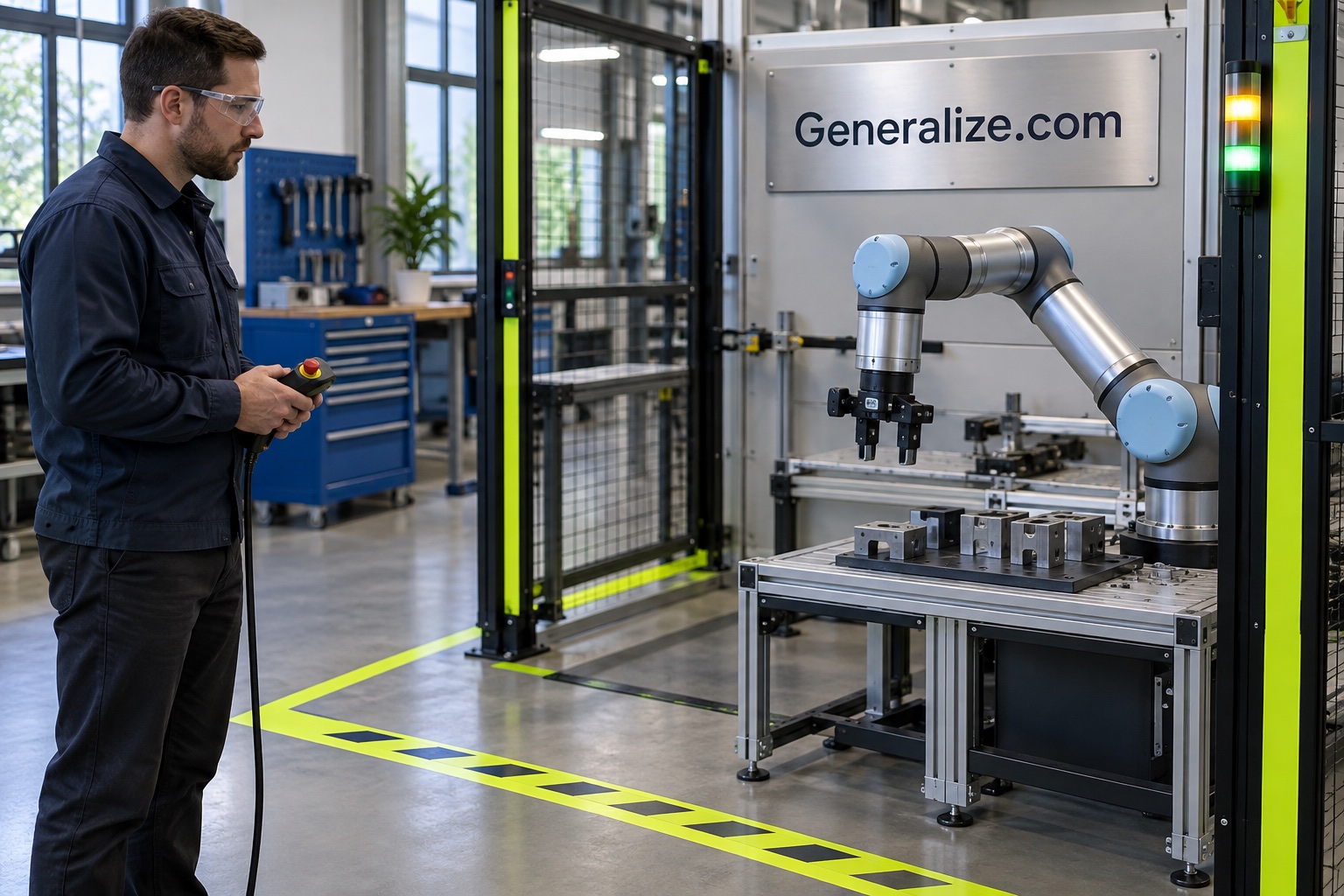
A robot that can handle more objects, scenes, and instructions may create more value. It may also encounter situations its designers did not anticipate. Broader capability therefore needs a visible boundary: what the system may do, when it must slow down, when it must stop, and when a person must decide. Generalize.com could become a product for defining and maintaining that safety envelope.
This is an illustrative business concept, not deployment guidance or a claim of conformity. Robot safety depends on the application, region, equipment, integration, and people exposed to hazards. ISO 10218-1:2025 covers safety requirements for industrial robots, while related standards address industrial robot applications and cells. A Generalize.com tool could help organize evidence and decisions, but it could not replace applicable standards, manufacturer instructions, or qualified risk assessment.
Start with the novelty register
The first offer could be a facilitated novelty register for a specific robotic application. The customer lists the conditions expected during normal work, the variations already tested, and the novel cases likely to appear. Each case is mapped to an allowed behavior and an owner.
Useful novelty categories include:
- an object with unfamiliar geometry, weight, material, or damage;
- a person entering or approaching the work area;
- an instruction that conflicts with the current task or approved procedure;
- a changed layout, blocked path, missing fixture, or moved station;
- lighting, occlusion, dust, glare, or sensor degradation;
- a software, model, tool, gripper, or payload change;
- a sequence error, incomplete upstream task, or unexpected downstream state.
The register is not a prediction of every possible event. It is a structured way to turn “the robot might see something new” into cases that engineering, operations, and safety teams can discuss.
Map each shift to a response
Every registered shift should have a response category. The simplest framework has four:
- Allowed: the condition is inside a tested operating range and normal controls apply.
- Constrained: the robot may continue with reduced speed, force, workspace, or action set.
- Stop: the system reaches a defined safe state and waits.
- Human review: an authorized person inspects the case and decides how work resumes.
These labels are only useful when connected to real control functions and procedures. “Stop” must identify which stop function or safe state applies. “Human review” must identify who is authorized, what information they receive, and whether they can resume remotely or must inspect the cell. “Constrained” must correspond to validated limits, not a vague request for the model to be cautious.
Generalize.com could store these mappings beside the detection signal, confidence or threshold, verification method, and change history. It could also flag a dangerous gap: a novelty detector may identify that something is unusual without identifying the underlying hazard. Low model confidence is one input to a decision, not a complete safety function.
A worked example: mixed-item depalletizing
Consider a robot that unloads known cartons from a pallet in a restricted cell. The approved range includes specified carton dimensions, weights, packaging condition, pallet location, and lighting. General capability might allow the perception system to recognize a wider set of cartons, but operations still needs boundaries.
The novelty register includes a crushed carton, loose strapping, an unknown cylindrical package, a pallet shifted outside tolerance, a person opening an access point, camera obstruction, and a proposed gripper replacement.
A slightly rotated known carton may remain allowed if it is within the tested range. A reflective package might trigger constrained operation or a request for inspection if perception quality drops. Loose strapping could require a stop because it introduces an entanglement hazard. A person entering the safeguarded space should connect to the designed protective system, not to a language model’s judgment. A new gripper should trigger change review and revalidation rather than being treated as another visual variation.
The product report would show the condition, signal, response, responsible owner, last review date, and supporting evidence. It would also show unresolved items. A blank response is not hidden by a high overall readiness score.
Connect model uncertainty to engineered controls
Machine-learning systems can provide confidence measures, out-of-distribution signals, ensemble disagreement, or other indicators. Their usefulness depends on calibration and context. A threshold that works in a curated validation set may behave differently after a camera move or seasonal lighting change.
Generalize.com could help teams record which uncertainty signal is used, how it was calibrated, the false-positive and false-negative tradeoff observed in the scoped test, and what downstream control consumes it. The tool should discourage one generic threshold across unrelated tasks.
It should also separate model signals from independent protective measures. Guarding, safety-rated monitored stops, speed and separation monitoring, emergency stops, and other controls have specific requirements and should be designed by qualified professionals for the application. A model confidence value should not be portrayed as a substitute for a safety-rated function.
Change management is part of the envelope
Safety boundaries decay when systems change. A new software build, updated policy, alternate camera, longer tool, different payload, or revised workflow can alter the assumptions behind earlier tests. The product needs configuration versioning and review triggers.
A change record could ask: which hazards or novelty cases are affected, which tests must be rerun, which instructions need revision, and who approves release? Small changes should not disappear into a general model version label. The exact robot configuration and operating assumptions belong beside every test result.
Incident and near-miss review also feed the envelope. When a novel condition appears in operation, the team should preserve the logs, determine whether the condition was anticipated, update the register, and decide whether the response should change. Generalize.com could manage that workflow without claiming to perform the investigation itself.
The buyer and distribution path
Early buyers could include robotics integrators, industrial operators, warehouse automation teams, and manufacturers introducing learning-enabled functions. The champion may be a functional safety engineer, controls lead, systems engineer, or site operations owner who needs one record shared across disciplines.
Integrators offer a credible distribution channel because they already translate robot capabilities into site-specific cells and acceptance plans. Generalize.com could supply a structured workspace they use with customers. Robot and component manufacturers could publish approved configuration information or integration notes, while customers retain their application-specific decisions.
The company should avoid becoming a document warehouse detached from the real system. Integrations with configuration management, test logs, incident systems, and deployment approvals would keep records current. Access controls and audit history would matter because these documents can contain sensitive facility and safety information.
What execution would require
The initial product needs a well-designed schema for hazards, shift types, signals, constraints, evidence, owners, approvals, and configuration versions. It needs templates by application without implying that a template completes a risk assessment. It needs exports that qualified reviewers can inspect without a proprietary viewer.
Editorial and product language need discipline. Avoid “certified safe,” “self-certifying,” or “autonomous safety” claims unless the exact claim is supported by the relevant process and authority. Distinguish a documented envelope from verified control performance. Keep benchmark capability separate from application safety.
The company would also need regional and sector focus. Requirements differ, and standards change. A realistic launch might support industrial robot cells in one market with qualified advisers, then expand carefully. Trying to cover every autonomous system and jurisdiction at once would weaken the product.
The first useful exercise
Choose one deployment task and write down five kinds of novelty it can encounter. For each, assign allowed, constrained, stop, or human review. Then ask what detects the condition, what physical behavior follows, who validates it, and what happens if detection is wrong. Any unanswered cell becomes a work item.
That worksheet could be the beginning of a valuable Generalize.com product. The name fits a company that helps wider capability remain bounded by explicit operating decisions. Generalize.com is available for acquisition, and prospective builders can inquire privately with the intended application, market, and review approach.